What is Narrow AI? Definition, Examples, Applications & Future Trends
Published: 13 Jan 2026
Have you ever wondered how Siri answers your questions, Netflix recommends movies, or self-driving cars navigate the streets? These intelligent systems work using Narrow AI, also known as Weak AI or Artificial Narrow Intelligence (ANI). Narrow AI is designed to perform specific tasks with high accuracy, but it cannot think, reason, or act beyond its programmed limits.
When we look at the different types of Artificial Intelligence, Narrow AI stands out as the most practical and widely used AI type today. Unlike General AI, which aims to mimic human intelligence, Narrow AI focuses on solving one problem at a time. This makes it faster, safer, and more reliable for real-world use.
From virtual assistants like Siri and Alexa to AI-powered recommendation systems, Narrow AI is already shaping our daily digital experiences. In this article, you will learn what Narrow AI is, its key features, real-life examples, applications across different industries, and how it compares with other types of AI along with insights into its future potential.
What is Narrow AI?
Narrow AI, also known as Weak AI or Artificial Narrow Intelligence (ANI), is a type of artificial intelligence that is designed to perform specific tasks. Unlike General AI, which can think and reason like humans, Narrow AI focuses on one problem at a time and cannot adapt beyond its programming.
For example, voice assistants such as Siri and Alexa, recommendation engines on Netflix and Spotify, and self-driving car systems all rely on Narrow AI. These systems are highly efficient in their areas, but they cannot perform tasks outside their designated functions.
In simple words, if you think of AI as the brain, Narrow AI is like a specialized tool: extremely good at its job but limited in scope. Understanding Narrow AI is essential for anyone curious about how AI is shaping real-world applications in daily life and industries.
Key Features of Narrow AI
- Task-Specific Functionality: Narrow AI, also called Weak AI or ANI, is designed to perform specific tasks only. It cannot go beyond its intended aim
- Limited Scope: Unlike General AI, Artificial Narrow Intelligence operates within a specific domain and cannot solve problems outside its area of expertise.
- High Efficiency: Narrow AI systems are high-speed and accurate in their tasks, such as recommending movies, diagnosing medical images, or detecting fraud.
- Data-Driven Performance: These systems rely heavily on large datasets to learn patterns and improve performance over time.
- No Human-Like Reasoning: Narrow AI lacks common sense and reasoning abilities, which means it cannot think, feel, or make decisions like humans.
- Adaptable Within Limits: Although ANI can improve within its task using machine learning, it cannot adapt to completely new, unrelated tasks.
- Real-World Applications: From voice assistants like Siri and Alexa to self-driving cars and recommendation systems, Narrow AI is widely used in daily life and industries.
Examples of Narrow AI
Narrow AI, also known as Weak AI or Artificial Narrow Intelligence (ANI), is widely used in our daily lives. These systems are designed to perform one specific task very well. Below are some common and easy-to-understand examples:
- Virtual Assistants: Siri, Alexa, and Google Assistant are prime examples of narrow AI. They can answer questions, set alarms, and control smart devices, but they cannot think beyond the orders.
- Recommendation Systems: Platforms like Netflix, YouTube, and Spotify use Artificial Narrow Intelligence to suggest movies, videos, or songs based on user behavior.
- Self-Driving Cars: Features like lane detection, auto-braking, and parking assist in cars use Weak AI to analyze roads and traffic conditions.
- Facial Recognition Systems: Smartphones and security systems use Narrow AI to recognize faces for unlocking devices or monitoring security.
- Email Spam Filters: Gmail and other email services use ANI to detect and block spam emails automatically.
- Chatbots & Customer Support: Many websites use AI chatbots to answer common questions and provide customer support quickly.
- Healthcare Diagnosis Tools: Narrow AI helps doctors analyze X-rays, MRIs, and medical data to detect diseases early.
- Fraud Detection in Banking: Banks use Artificial Narrow Intelligence to identify unusual transactions and prevent fraud.
Advantages of Narrow AI
Narrow AI, also known as Weak AI or Artificial Narrow Intelligence (ANI), is designed to handle specific tasks with high efficiency. Due to its focused nature, Narrow AI provides fast, accurate, and reliable results in real-world applications. When compared with the broader advantages and disadvantages of Artificial Intelligence, Narrow AI offers clear benefits but also comes with certain limitations.
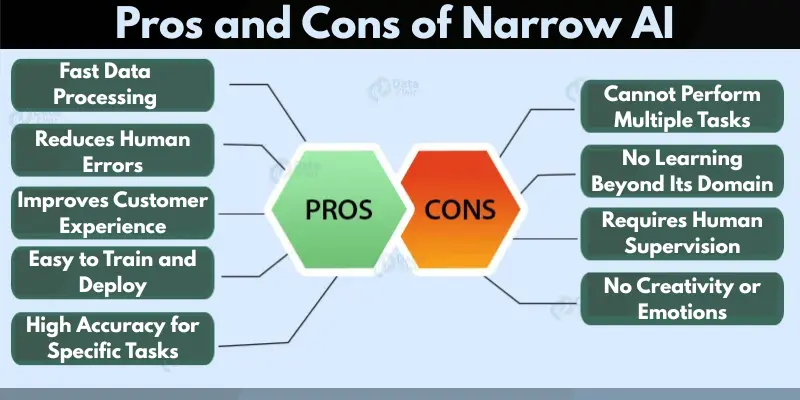
- High Accuracy for Specific Tasks: Narrow AI excels in a single task, such as facial recognition, voice commands, or medical image analysis.
- Fast Data Processing: Artificial Narrow Intelligence can analyze large datasets in seconds, helping businesses make quicker decisions.
- Cost-Effective Automation: Companies use Weak AI to automate repetitive work, which saves money and reduces manual effort.
- Reduces Human Errors: Narrow AI follows data-based rules, which helps lower mistakes in fields like finance, healthcare, and manufacturing.
- Improves Customer Experience: Chatbots, recommendation systems, and virtual assistants powered by ANI provide faster and more personalized services.
- Works 24/7 Without Breaks: Unlike humans, Narrow AI systems can operate continuously without fatigue.
- Easy to Train and Deploy: Because it focuses on a single task, Artificial Narrow Intelligence is easier to develop and implement.
Limitations of Narrow AI
Although Narrow AI, also known as Weak AI or Artificial Narrow Intelligence (ANI), is very effective for specific tasks, it has several limitations. These limitations explain why Narrow AI cannot replace human intelligence or General AI.
- Cannot Perform Multiple Tasks: Narrow AI is designed for one specific task only and cannot handle different or unrelated tasks at the same time.
- Lack of Human-Like Understanding: Artificial Narrow Intelligence cannot think, reason, or understand context like humans.
- No Learning Beyond Its Domain: Even if ANI improves through data, it cannot apply that learning to new or unfamiliar situations.
- Highly Dependent on Data Quality: Narrow AI systems rely on large and accurate datasets; poor data leads to poor performance.
- Fails in Unexpected Situations: Weak AI struggles when faced with scenarios that were not included in its training.
- No Creativity or Emotions: Narrow AI cannot show creativity, emotions, or common sense like humans.
- Requires Human Supervision: Most Narrow AI systems still need humans for monitoring, updates, and decision validation.
Applications Across Industries
Narrow AI, which is also called weak AI or artificial narrow intelligence (ANI), is used in many fields to make things more accurate and efficient. Narrow AI helps businesses automate tasks and make better decisions because it focuses on one thing at a time.
- Healthcare: Narrow AI is used to analyze medical images, detect diseases, and assist doctors in diagnosis and treatment planning.
- Finance & Banking: Artificial Narrow Intelligence helps in fraud detection, credit scoring, algorithmic trading, and risk management.
- E-commerce & Retail: Recommendation systems powered by Weak AI suggest products based on user behavior and shopping history.
- Transportation: Self-driving car features, traffic monitoring, and route optimization rely on Narrow AI systems.
- Customer Support: AI chatbots and virtual assistants handle common customer queries and provide 24/7 support.
- Manufacturing: Narrow AI is used for quality control, predictive maintenance, and process automation in factories.
- Education: Personalized learning platforms use ANI to recommend courses and track student performance.
- Cybersecurity: Artificial narrow intelligence detects suspicious activities and protects systems from cyber threats.
Future of Narrow AI
The future of Narrow AI, which is also called Weak AI or Artificial Narrow Intelligence (ANI), looks very bright in all fields. Narrow AI systems will become more accurate, useful, and widely used as data quality and computing power improve.
- Smarter Automation: Narrow AI will automate more routine and complex tasks in healthcare, finance, and manufacturing.
- Better Personalization: Artificial Narrow Intelligence will offer more personalized experiences in education, e-commerce, and entertainment.
- Improved Accuracy with Better Data: As datasets improve, Weak AI systems will deliver more reliable and precise results.
- Stronger Human–AI Collaboration: Narrow AI will support humans in decision-making rather than fully replacing jobs.
- Ethical and Responsible AI Growth: The future of ANI includes better data privacy, reduced bias, and responsible AI usage.
- Expansion into New Industries: More sectors like agriculture, logistics, and smart cities will adopt Narrow AI solutions.
- Foundation for Advanced AI: Narrow AI will continue to serve as the base technology for developing more advanced AI systems.
Conclusion
Understanding what narrow AI is helps us see how artificial intelligence is already shaping our daily lives. Also known as Weak AI or Artificial Narrow Intelligence (ANI), Narrow AI is highly effective at performing specific tasks such as voice recognition, recommendations, fraud detection, and medical analysis.
Although Narrow AI cannot think or reason like humans, its accuracy, speed, and efficiency make it essential across industries. As technology advances, Narrow AI will continue to improve automation, support human decision-making, and drive innovation. Learning about Narrow AI today prepares us for a smarter and more AI-powered future.
Frequently Asked Questions (FAQs)
Below are some common questions that help readers better understand what Narrow AI is, how it works, and why it is important in real life.
Narrow AI is a type of artificial intelligence designed to perform one specific task. It cannot think or act beyond its assigned function.
Narrow AI is called Weak AI because it lacks human-like intelligence and reasoning. It only follows programmed rules and data.
Examples of Artificial Narrow Intelligence (ANI) include Siri, Alexa, Netflix recommendations, email spam filters, and facial recognition systems.
No, Narrow AI cannot become General AI on its own. It is designed for limited tasks and needs advanced research to reach human-like intelligence.




- Be Respectful
- Stay Relevant
- Stay Positive
- True Feedback
- Encourage Discussion
- Avoid Spamming
- No Fake News
- Don't Copy-Paste
- No Personal Attacks
- Be Respectful
- Stay Relevant
- Stay Positive
- True Feedback
- Encourage Discussion
- Avoid Spamming
- No Fake News
- Don't Copy-Paste
- No Personal Attacks
