From Efficiency to Ethics: Navigating AI’s Benefits and Risks
Published: 10 Oct 2025
One of the most widely discussed technologies in the world today is artificial intelligence (AI). AI is changing the way we connect, work, and live, from voice assistants on our phones to self-driving cars and sophisticated medical equipment. It is made to think, learn, and make decisions much like a person, but faster and more precisely.
AI offers numerous benefits, including time savings, increased productivity, and the ability to solve complex problems. However, there are drawbacks as well, such as exorbitant expenses, employment losses, and moral dilemmas. Since AI impacts not just businesses but also our daily lives, it is critical to comprehend both its advantages and disadvantages.
In this guide, we will explore the advantages and disadvantages of Artificial Intelligence simply and clearly, so you can see how it impacts the present and the future.
Advantages of Artificial Intelligence
Artificial Intelligence is changing how we work and how we live. It makes tasks faster, smarter, and more accurate. The following are the main benefits of AI:
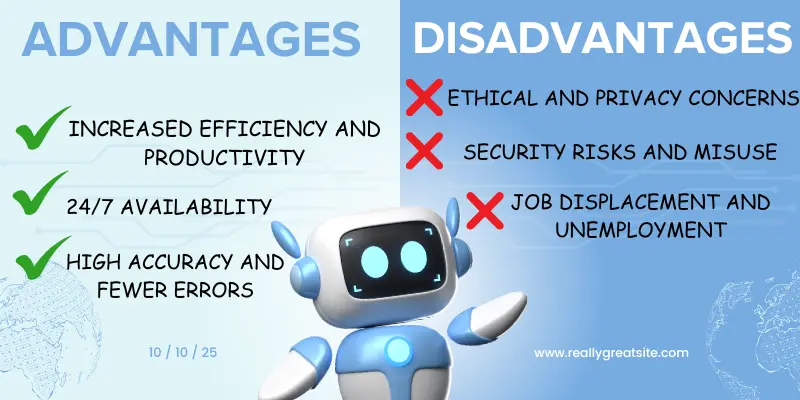
1. Increased Efficiency and Productivity
AI can do things quicker than humans and does not need pauses or rest. This makes procedures faster and more dependable. In industries, AI devices can run continuously without slowing pace. As a result, productivity and efficiency rise significantly.
2. High Accuracy and Fewer Errors
AI systems use precise programming and logical procedures, which decreases human mistakes. In healthcare, AI algorithms are more accurate than humans in detecting illnesses and reading scans. Banks and financial institutions also employ AI to prevent transaction errors. This makes AI a reliable option for error-free labor.
3. 24/7 Availability
Unlike humans, artificial intelligence does not become weary, bored, or distracted. It may labor day and night without rest or nourishment. Chatbots, for example, may deliver immediate responses at any time of day. This round-the-clock support enhances the user experience and pleasure.
4. Improved Decision-Making
AI analyzes vast volumes of data in seconds, providing important insights. Businesses utilize AI to forecast consumer behavior, market trends, and dangers. This enables managers to make better, faster judgments. AI makes decision-making more accurate and data-driven.
5. Personalization of Services
AI analyzes user activity and provides personalized services depending on their behavior. YouTube, for example, recommends films you might enjoy, while e-commerce sites display things you are most likely to purchase. This level of customisation helps the consumer feel appreciated. It also promotes client loyalty and pleasure.
6. Cost Savings in the Long Run
Although AI is expensive to implement, it saves a significant amount of money in the long run. It minimizes labor expenses by automating processes that often need a large number of humans. AI also avoids costly errors by operating with great precision. AI helps firms increase their profitability over time.
7. Automation of Repetitive Tasks
AI automates difficult and repetitive tasks that humans find tiring. For example, data entry, sorting emails, and routine calculations can be automated. This saves a huge amount of time for employees. It allows humans to focus on creative and important work instead.
8. Enhanced Data Processing and Analysis
AI can manage large volumes of data in ways that humans cannot. It extracts hidden patterns and insights from the data in minutes. This helps businesses enhance their strategy and offerings. AI analysis is particularly useful in fields such as marketing, healthcare, and research.
9. Innovation in Different Industries
Many modern technologies rely on artificial intelligence, including smart assistants, self-driving automobiles, and medical robots. These innovations improve safety, speed, and comfort. In healthcare, AI assists surgeons with complicated procedures. In transportation, it facilitates transit and lowers accidents.
10. Consistent and Unbiased Performance
Humans frequently become tired, emotional, or distracted when working. In contrast, AI operates consistently. It produces constant outcomes with no mood fluctuations. This makes AI more dependable and devoid of emotional bias in decision-making.
Disadvantages of Artificial Intelligence
While artificial intelligence provides several benefits, it also presents a number of challenges. These drawbacks impact employment, ethics, and even security. Here are the major disadvantages of AI:
1. Job Displacement and Unemployment
Artificial intelligence can replace human labor in companies, offices, and even customer service. This results in fewer career options for people, particularly in repetitive jobs. As automation advances, many workers may struggle to find new jobs. It presents economic and social issues to communities.
2. High Development and Maintenance Costs
AI systems demand a significant investment in technology, software, and hardware. Maintenance and regular upgrades can increase the cost. Small firms frequently cannot afford these fees. This makes AI more widespread in large corporations than in small businesses.
3. Lack of Creativity and Emotional Understanding
AI relies solely on logic and statistics and is unable to think creatively, like humans do. It lacks emotions, empathy, and human judgment. For example, AI can recommend music but cannot genuinely understand the emotions underlying it. This restricts its ability to form deeper connections with others.
4. Risk of Over-Dependence on Machines
People may grow overly reliant on AI as technology gets more integrated into everyday life. This reliance reduces human problem-solving abilities over time. If AI malfunctions or becomes unavailable, it can create significant disruptions. Over-reliance impairs humans’ critical thinking abilities.
5. Ethical and Privacy Concerns
AI systems frequently gather and analyze personal data, which raises privacy concerns. If sensitive information is not managed appropriately, it may be abused or leaked. Ethical considerations arise when AI is employed for surveillance or monitoring. This makes individuals concerned about their safety and freedom.
6. Bias and Unfair Decision-Making
AI learns from data, and if the data is biased, the results will also be biased. For example, hiring software may favor certain groups over others. This creates unfair outcomes that affect people’s lives. Eliminating such bias in AI is very difficult.
7. Security Risks and Misuse
Hackers may utilize AI to launch cyberattacks, steal identities, and reproduce misleading data. Deepfakes and AI-powered weaponry are both scary instances. Such abuse may destroy individuals, corporations, and even entire countries. This makes AI a two-edged sword.
8. Reduced Human Interaction and Deskilling
With AI managing customer support and services, human-to-human engagement is reduced. This might leave people feeling alienated and unconnected. Workers may lose essential abilities over time as AI takes over their duties. This inhibits both creativity and personal growth.
9. Difficulty in Explaining AI Decisions (Lack of Transparency)
Many AI systems operate like a “black box,” making it difficult for humans to understand how they make judgments. This lack of openness makes it difficult to believe AI outcomes. Unexplained judgments might be harmful in crucial sectors such as healthcare and law. People require clarity, which AI frequently falls short of.
10. Limited Flexibility Outside Programmed Tasks
AI is built to do certain tasks and cannot simply adapt outside of its programming. For example, a chess-playing AI cannot suddenly learn to drive. Humans can learn and adapt fast, but AI lacks this flexibility. This limits its usefulness in unforeseen settings.
AI’s Impact in Various Fields
Artificial intelligence is altering many aspects of our everyday lives and careers. AI is making a significant impact on everything from hospitals to schools and transportation. Let us have a look at how AI is influencing various sectors:
1. Healthcare
Many hospitals now utilize AI technologies to save time and enhance care by assisting with treatment planning, medical imaging, and even patient monitoring. With AI, clinicians can diagnose illnesses more quickly and accurately.
2. Education
In schools and universities, AI makes learning easier and more personal. It can suggest lessons based on a student’s level and help teachers track progress. Online learning platforms also use AI for smarter teaching methods.
3. Business & Finance
AI is commonly utilized in business to analyze data, provide customer support, and detect fraud. Many businesses utilize chatbots and smart technologies to help clients. In finance, artificial intelligence aids in trend prediction and decision-making.
4. Transportation
AI is driving big changes in transport, especially with self-driving cars. It improves traffic control, delivery systems, and safety on roads. Smart navigation apps also use AI to give real-time route suggestions.
5. Security & Safety
AI can help security systems with facial recognition and danger detection. It aids in monitoring huge regions and detecting odd activities. This makes both public and private areas safer.
6. Entertainment & Media
From Netflix suggestions to video games, AI influences how we consume media. It tailors material to users and even produces music, art, and films. This has made entertainment more engaging and thrilling.
Conclusion
There are advantages and disadvantages to artificial intelligence. It may make our lives simpler, quicker, and smarter, but it also introduces concerns such as job loss, data breaches, and over-reliance on machines. The key is balance. If we utilize AI intelligently, it has the potential to be a great tool for improving education, healthcare, business, and daily life.
Now it’s your turn: how do you envision AI affecting your future? Share your opinions in the comments section below, and we’ll start a meaningful debate. If you found this post useful, be sure to check out our other articles to stay up to speed on the newest tech trends.
Frequently Asked Questions [FAQs]
Here are some common questions about Artificial Intelligence that people often ask, along with clear answers to help you understand better:
AI saves time, increases accuracy, and makes tasks easier. It helps in areas like healthcare, education, business, and customer service.
AI can reduce human jobs, raise privacy concerns, and make people overdependent on machines. It also requires high costs to build and maintain.
AI’s negative implications include employment loss, since robots can replace human labor in a variety of industries. It can also pose privacy and security problems because AI systems frequently access vast volumes of personal data. Overreliance on AI may limit human abilities and inventiveness, while mistakes or biased data might result in unjust or harmful conclusions.
Furthermore, AI development and upkeep are expensive, making it difficult for small enterprises to implement. These difficulties demonstrate that, while AI is strong, it also brings significant obstacles.
The greatest risk of AI is losing human control. If AI systems get too advanced or are employed without sufficient guidelines, they might make destructive judgments, distribute misleading information, and even endanger employment and security. The true danger resides in overuse and a lack of regulation.
AI automates many tasks, which can replace some jobs. At the same time, it creates new job opportunities in AI development, data analysis, and technology fields.



- Be Respectful
- Stay Relevant
- Stay Positive
- True Feedback
- Encourage Discussion
- Avoid Spamming
- No Fake News
- Don't Copy-Paste
- No Personal Attacks
- Be Respectful
- Stay Relevant
- Stay Positive
- True Feedback
- Encourage Discussion
- Avoid Spamming
- No Fake News
- Don't Copy-Paste
- No Personal Attacks
